Showing posts with label college. Show all posts

Sunday, September 16, 2012

Run for the money

A couple of weeks ago, I was half-heartedly listening to a recap of college football scores while giving my toenails their last coat of polish before fall. I say “half-heartedly” because the level of artistry that goes into masking the grotesqueness of my feet requires a high degree of concentration.

When they started talking about ridiculous blowouts, my ears perked up and my foot flinched. In an instant, my impeccable paint job was ruined by an errant streak of Midnight Sapphire on my big toe. Why? Because there is one part of college football that has always fascinated me: money games.

For those of you who are unfamiliar with this phenomenon, the simplest and least tasteful explanation can be delivered in a single word—prostitution.

Early in the season, powerhouse schools like to schedule an easy game or two to dust off the cobwebs, build confidence and impress their home crowds with a dominating win. To do this, they seek out smaller, lesser-known teams and pay them to get their asses kicked.

Small colleges usually have small athletic budgets, which makes this sort of deal extremely lucrative for them. Most don’t think twice about pimping out their football teams for 3, 4, even $500,000—or more. Then they put the players on a nice charter plane—compliments the opposing team, of course—and pray that they all come back alive and with the majority of their limbs (and cognitive function) intact.

The result? Scores like “North Carolina-62, Elon-0,” “Florida State-55, Savannah State-0,” and “TCU-56, Grambling State-0.”

In some cases, it’s almost sad. I feel for the guys on the losing side of the scoreboard. I don’t care where you play—if you’re a college athlete, you are a competitive person. And competitive people hate losing.

If it were up to them personally, I’m sure there are some morally grounded players out there who would refuse to lose for cash. Back in my days as a legit athlete, I probably would have agreed with them. But now that I’m just a lowly has-been, I would be willing to bend my ethical standards under the right conditions.

So that got me to thinking—what if they developed a similar system in the world of competitive distance running? I mean, think about it: when people watch world-class distance runners race other world-class distance runners, there is really no way of grasping just how fast they are moving. It doesn’t help that they all look like they’re out on a leisurely joggy-jog when, in fact, they are splitting sub-60s.

But if you threw in a race where world-class distance runners raced middle-of-the-road distance runners—former Big Sky Conference Championship bronze medalists, for example—the audience would be able to see just how good these Olympians really are.

Take Kara Goucher, for example—America’s Sweetheart of distance running. High school cross-country runners idolize her. They probably cheered her on during last month’s Olympic marathon. She finished just a hair over 2:26—a time that most men, even really good ones, could only dream of achieving—which was good for 11th place.

Except that in America’s eyes, 11th place is not good. It’s not good at all. In fact, you probably already forgot that Kara Goucher even participated in the Olympic marathon.

Here in the good ol’ U.S. of A., we like winners—the bigger and more embarrassing the margin of victory, the better. The way I see it, there is only one way for Kara to avenge that 11th place disaster (besides winning gold in Rio, which probably won’t happen if Ethiopia still exists in 2016): winning a race by a laughably obscene margin.

That’s where I (or some other washed-up has-been) would come in. I could be the Grambling State to her TCU. I could sort of, but not really, compete with her and make her look really, really good. I could get her fans all fired up and give her a solid foundation of confidence for the rest of the season. All I would ask for in return would be a small* percentage of her race winnings.

So Kara, once you realize how incredibly genius this idea is, drop me a line. My inbox—and your comeback—awaits.

*Less than a majority** share.
**Between 1 and 49 percent.  

Wednesday, April 6, 2011

Exceleration

Rejection sucks.

Just ask any guy who ever had his tender teenage heart broken by his dream high school prom date. But after being turned down by Little Miss Popular, at least he could console himself with the knowledge that she and her blonde highlights were way, way out of his league.

Being rejected for jobs that I am totally qualified for, however, is a completely different story. It’s like being turned down by the girl who heads up the high school bird watching club and doesn’t brush her hair.

I graduated college with lofty expectations of immediately discovering and launching myself into my dream career. Several unreturned messages and a few middle fingers (both given and received) later, my outlook has turned from “Reese Witherspoon, Legally Blonde” to “Martin Short, Pure Luck.”

Forget actual skilled positions—apparently, I’m not even qualified to be a secretary at the companies in my field due to my lack of professional experience with multi-line phones and Microsoft Office.

I’ve been told that I just need to tweak my résumé a bit—you know, buff up my qualifications and experience. In blunter terms, I need to lie.

The problem is, when people lie about work experience, they often get caught. Remember what happened to Al Gore when he claimed to have invented the Internet? I’m just not willing to risk that kind of humiliation. Plus, I’m a horrible liar. Even if I were able to fill my résumé with fake work history, I would almost certainly blow my cover in a face-to-face interview, which, I imagine, would go something like this:

Snooty Interviewer: So, tell me about your background and qualifications.

Me: Well, I graduated college with high honors, completed an undergraduate research project, became fluent in Spanish, and earned 12 varsity athletic letters.

Snooty Interviewer: Hmmm…I see. And tell me, did you acquire any experience using Microsoft Excel during your time as a secretary at…what was the name of the company?

Me: Oh, yeah, that was um…Technology Suppliers Unlimit—yeah, actually, I…um…well, I made that up.

To me, it seems entirely absurd that I would have to resort to fabricating experience with Microsoft Excel just to get an entry-level administrative job. No, I haven’t spent the last three years typing numbers into little rectangles, but give me ten minutes—I bet I could figure it out.

In fact, just to prove to myself, my potential employers, and anyone who has nothing better to do than read this blog that I am indeed capable of using Excel in a professional capacity, I have created a series of graphs derived from actual data I entered into an actual Excel spreadsheet. So put that in your chart and wizard it.


Wednesday, March 30, 2011

A new "fun"tier

Still amped up on dopamine from my little Good Samaritan episode, I set out on a leisurely afternoon jog through my neighborhood. Although I had no intention of attempting another round of sprint intervals, I decided to take a route that passes by the high school track.

In the distance, I could see a crowd of people gathered in the stadium. As I got closer, I realized it was a group of high school track and field athletes. Track practice.

I stopped and peered through the chain link fence, overcome by the sort of wistful nostalgia Britney Spears might experience by looking at a wall calendar from the year 1999.

At that moment, I made the strangely painful realization that my days of reporting to afternoon practice were gone forever. I would never again be forced to complete crippling workouts that left me sore and fatigued for days. I would never again be expected to race so hard that I had to stagger to the bathroom and sit on the toilet with a puke bucket for half an hour. That made me sad.

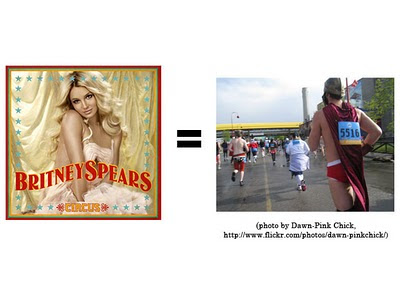
But you know what? Britney (sort of) successfully revitalized her career, and I can too. You see, …Baby One More Time was the Britney equivalent of my high school and college racing career: the peak, the zenith, the I’ll-never-ever-be-that-good-again era of success.


Let’s be honest: Circus was no …Baby One More Time. But it was still a successful album, and you have to admit that Britney is still entertaining, whether she’s singing and dancing on stage or assaulting paparazzi with an umbrella. Circus is to Britney what 5K fun runs are to me. (I know, I know, it’s a terrible analogy, but I’ve been out of school awhile and my cognitive abilities have deteriorated substantially. Work with me.)


What fun runs lack in legitimate competition, they make up for in entertainment value and enjoyment. In fact, I might—scratch that, I will—even go so far as to say that fun runs are actually better than serious races. After reading the rest of this post, I think you’ll agree.

Why fun-runs are waaaaaaaaaayyyy cooler than school-sanctioned racing events: a post within a post (not to be confused with that dream within a dream Inception crap)


1.) Degree of pressure


When you and your teammates are getting reading to run a race that actually matters, everyone acts all serious as they silently change into their spikes, pin on their race numbers, and apply their Breathe Right nasal strips:


But at a fun run, the typical pre-race environment looks more like this:


(photo by Dawn-Pink Chick, http://www.flickr.com/photos/dawn-pinkchick/)


2.) Uniforms


As a member of a school-sponsored team, you must compete in a (yawn) team-issued uniform:


At a fun run, you are free to choose your own uniform:


(Photo by Stuart Chalmers, http://www.flickr.com/photos/gertcha/)


3.) Expected effort


When you are competing for team points, scholarship money, or a spot on the varsity team, you are expected to look like this after you cross the line:


It is generally not encouraged to pass out, pee yourself, and/or vomit after finishing a fun run. That sort of behavior is frightening to young children and tends to put a damper on the festive mood:


Let’s take a look at a side-by-side photo comparison:


4.) Awards


If you win a race at an important meet (like conference or state), you’ll likely receive another boring medal or ribbon. (Woo. Hoo.):


But if you’re a top finisher at a fun run, you’ll probably get a supercool prize:


Like a trophy with a golden buffalo topper (a great conversation piece):


Or a beach glass sculpture thingy:


Or even a souvenir pint glass (perfect for drinking a much-deserved post-race bee—er, Gatorade):


On a completely unrelated note, today is my dad's birthday. Happy birthday, Dad!

Sunday, March 20, 2011

If tees could talk

From the moment you were old enough to understand the difference between designer denim and Lee Dungarees, fashion was important. If you were forced to endure the everyday popularity contest that was junior high, you might recall begging your parents for overpriced crap with brand names like Billabong plastered all over it.

High school was more of the same. You put considerable thought into choosing your daily wardrobe. You even packed color coordinated shirts, shorts, and scrunchies for afternoon sports practice.

Then you went off to college. With finals and papers and late-night games of flip cup, it was enough of a struggle to show up to class. Your fashion standards slipped, little by little, until oversized sunglasses, mismatched sweats and Ugg boots became your signature look.

And your workout attire? Well, since you were too lazy to do laundry more than once a month, you constantly found yourself fishing at the bottom of your t-shirt drawer. You would wear any clean shirt you could get your hands on, regardless of whatever logo or ridiculous slogan happened to be printed on it.

And that, my friends, is risky business. Sometimes, what you think your clothes say about you—if you have indeed thought about it—is very different from the actual message you are inadvertently communicating to your peers.

To better explain what I mean, I have provided paired examples in six different categories. The following is based on real observations at an actual college gym:


Category #1: The billboard shirt

(A)


What you think it says: “I am environmentally conscious. I now use this shirt—which I received as a birthday/Christmas/eighth grade graduation gift when I was 14—as a cutoff workout tee. Reduce, reuse, recycle!”

What it actually says: “I still feel guilty about letting my mom pay $84 for a white cotton t-shirt, and I am going to keep wearing it until it literally falls off of my body—which shouldn’t be too long, considering it was made in Honduras at a cost of approximately 17 cents.”


(B)


What you think it says: “Wings and beer! Yum!”

What it actually says: “Scantily clad girls with low standards! Yum!”


Category #2: The sports team shirt

(A)


What you think it says: “Long live the Who Dat Nation, ya'll!”

What it actually says: Same. You’re actually pretty safe with this one.


(B)


What you think it says: “I am a loyal fan who sticks by my team through thick and thin. I am a champion of underdogs everywhere.”

What it actually says: “I have become accustomed to failure. I don’t mind losing or being subjected to public embarrassment over and over again.”


Category #3: The sporting event shirt

(A)


What you think it says: “I completed an Ironman triathlon. That means I’m a legit athlete.”

What it actually says: “My training is more important yours. So get off that treadmill and do your power walking at the mall.”


(B)


What you think it says: “I am a kind and generous person. I volunteered my time for the benefit of athletes with disabilities.”

What it actually says: “I (might have) competed in the Special Olympics.”


Category #4: The concert shirt


(A)


What you think it says: “I saw Tom Petty live and in concert. It was awesome, and so am I.”

What it actually says: Same. Again, you’re safe here. (No bias whatsoever. I definitely do not own a souvenir t-shirt from Tom Petty’s 2008 summer concert series.)


(B)


What you think it says: “I don’t care what people think about me. Miley Cyrus is a talented artist and performer, and Hannah Montana should have won an Emmy.”

What it actually says: “I am secretly a 15 year-old girl. Or Billy Ray Cyrus.”


Category #5: The non-profit organization shirt


(A)


What you think it says: “I support the constitutional right to bear arms.”

What it actually says: “I have a house full of creepy animal heads.”


(B)


What you think it says: “I support the fight against animal cruelty.”

What it actually says: “We could never be friends because I would judge you for eating chicken McNuggets.”


Category #6: The cheesy slogan shirt

(A)


What you think it says: “I have a special affinity for the Lone Star State and the people who live there.”

What it actually says: “George Bush! Chicken fried steak! Yeaaaaaaahhhhhh!”


(B)


What you think it says: “Look at me! I have a sense of humor!”

What it actually says: “Don’t mess with (Walker), Texas (Ranger).”

Monday, March 7, 2011

Who knew spandex could be so inspirational?

Well folks, it's that time of year again—the time when skinny kids run in circles and sharp metal objects fly through the air. Track season! With most spring season openers just around the corner, I thought now would be a good time for me to unveil the poster campaign I’ve put together to generate interest about a sport most people ignore—either unintentionally or totally on purpose. I realize this design has become quite cliché in recent years, but I simply could not resist putting my own tracktastic twist on the ubiquitous motivational poster spoof. Prepare to be inspired. (Note: all images are from my personal archives and albums unless otherwise noted. I don't want to get sued if this thing gets huge.)


(image from montanagrizzlies.com archives)


Monday, February 28, 2011

Gym stereotypes: college edition

According to the feedback I’ve received from my most loyal readers (thanks Mom and Dad!) my post about stereotypical gym characters was a smashing success. So I have decided to produce a spin-off—let’s hope it’s better than Joey.

College rec centers are like the Marshmallow Mateys of indoor fitness facilities. On the surface, they look, smell and taste pretty much the same as the real thing. But when you take a moment to chew more slowly and really concentrate on the distinct combination of flavors and textures, you’ll realize that something is slightly off. Marshmallow Mateys are not Lucky Charms, and college gyms are not regular gyms.

As with any gym, though, university rec facilities harbor several distinct, stereotypical groups of exercisers. The following line-up is based on over four years of informal research conducted in the rec center at my alma mater.

The Newbies: These wide-eyed 18-year-olds usually travel in groups of friends they probably met at last night’s floor snack. They wander aimlessly through the gym, talking about trying different machines but never actually committing to one exercise for more than five minutes. At the end of their “workout,” they can be spotted purchasing smoothies at the snack bar with their meal plan swipe cards, thus outing themselves as freshmen, because seriously, who else would pay $6.00 for a cup of banana puree? Other key defining traits: high school sports t-shirts, university lanyards, visible insecurity.

The Dudes who are Trolling for Chicks: They work out in pairs (one dude-on-the-prowl, one wingman) and try to pass by the cardio section as many times as possible over the course of their workout. Each time they cruise by the row of elliptical machines, they consciously puff out their chests, flex their biceps, and walk like they’re carrying a keg under each arm. Other key defining traits: Hurley brand t-shirts (cut-off sleeves optional), backwards flat-brimmed baseball caps, cubic zirconia ear studs.

The Chicks who are Trolling for Dudes: These are the girls who come to the gym looking like they just wrapped a photo shoot for the spring Nike catalogue. Everything—from their brand new Nike Frees to their no-slip elastic hair bands—is color coordinated, probably in hot pink or neon purple. They pretend to be interested in the latest issue of Star magazine as they move just fast enough to keep the elliptical from slipping into energy conservation mode. Each time a remotely good-looking dude walks by, they push out their cleavage, stare seductively into his eyes, and flutter their mascara-clumped eyelashes. Other key defining traits: vanilla lattes, cakey makeup, bedazzled cell phones.

The Honors Students: Between their graduate-level organic chemistry courses and their weekly conference calls with Ben Bernanke, these scholastic overachievers have virtually no time to devote to the sole pursuit of physical fitness. But being the brilliant problem-solvers that they are, they have devised a system in which they can work out, write their doctoral dissertations, and catch the latest episode of Jeopardy!, all in one fell swoop. You can catch them in action in the stationary bikes area, where they can be seen pedaling feverishly as they work multi-page calculus problems and yell out phrases like, “What is the epiglottis?!” Other key defining traits: ankle socks, prescription goggles, high earning potential.

The Scrawny but Sporty Guys: Their beanpole physiques might have cut it in their high school basketball days, but once they set foot on a college campus, they realized they needed to beef up if they wanted to impress the ladies. These guys are serious about building muscle—they’ve really taken the whole “no pecs, no sex” joke to heart. They can be seen shadowing their bigger, buffer peers in the weight room, carefully imitating their every move with weights that are obviously too heavy. Other key defining traits: visible clavicles, baggy basketball shorts, lower back strains.

The Ban-the-Bombers: They use pickle jars as water bottles and shop exclusively at Goodwill and the farmers’ market. In their crusade against big business corruption, they have boycotted companies like Nike. If you make the mistake of engaging them in friendly conversation, they will try to convince you to sign up for their next sit-in protest and trade your new Nike Shox for clogs made of recycled organic clay. Other key defining traits: Sierra Club t-shirts, nose rings, hemp necklaces.

The Health-Conscious Professors: They’ve never heard of an iPod, but they are perfectly content to read the latest issue of The Economist as they power-walk their way to lower blood pressure. Often sporting t-shirts from obscure athletic events of the 1980s—like The 2nd Annual “Let’s Get Physical” 7-Mile—these sagely scholars are here to not only manage their high cholesterol, but also to show all the young whippersnappers that they’ve still got it. Other key defining traits: tortoise shell eyeglasses, ear hair, striped cotton tank tops.

The Track Team: They’re loud, they’re sweaty, and they are definitely exceeding the half-hour time limit for the treadmill they’re using. You came to the gym hoping to enjoy a leisurely trot around the indoor track. Little did you know, the trackies were planning to sabotage your joggy-jog with a battery of sprint intervals. You cower in the corner, wondering why they can’t just work out in their own facility. The truth is, their athletic department is too cheap to spend money on sports other than football, so they don’t actually have a team facility. Come to think of it, you didn’t even know there was an indoor track team. Other key defining traits: speed suits, gold chains, short shorts.

Saturday, February 26, 2011

GTL: Gym, Tan, Loofah

According to recent reports, actress (if you can even call her that anymore) Lindsay Lohan is being sued by a Nevada-based spray-tan company over an alleged unpaid tab of some $41,000.

When I heard this story, I was dumbfounded for two reasons:

(1) Who in their right mind allows Lindsay Lohan to purchase something on credit?

(2) Who in their right mind pays $41,000 to look like they OD’ed on beta-carotene?


Granted, I’m sure no one, other than LiLo’s busy legal team, would take on the challenge of defending her sanity. But regardless of whether she is sober or mentally stable, I’m pretty sure she’s not blind.

I do have to admit, I kind of feel for poor Lindsay—when it comes to her skin tone, that is. (I don’t want to be accused of condoning cleptomania, alcoholism, or Labor Pains.)

You see, I too suffer from extreme epidermal pallidity due to the misfortune of inheriting 50 percent of my genes from a redhead. After years of denial, I have finally accepted that my skin rejects any and all shades between “almost transparent” and “so burnt it hurts to stand in a stiff breeze.”

On a recent trip to Phoenix, my mom and I spent the afternoon sitting by the pool—under umbrellas. As the sun moved across the cloudless sky, we chased the shade around the pool while other hotel patrons oiled and rotated their way to perfectly sun-kissed skin.

But I wasn’t always so at peace with my pastiness. Like Lindsay, I did some pretty stupid things in an attempt to cheat nature—though to be fair, none of them resulted in a debt of forty grand.

During my freshman year of college, I had my first experience with indoor tanning. With the encouragement of my roommate—who spent her summers working as a lifeguard—I marched over to the campus salon and purchased a tanning package. For years, my self-confidence—on the track and off—had been compromised by my blinding whiteness.

Whenever I lined up at the start of a race, I couldn’t help but feel athletically inferior to the girls whose golden complexions exuded an aura of physical fitness. Of course, my theory on the relationship between tanness and athletic ability was rarely supported by actual race results.

Still, there was no changing my mind. While other UM co-eds flocked to the tanning salon in preparation for their spring break trips to Cabo, it wasn’t the allure of a bikini-ready glow that drew me in to the tanning bed. I just wanted to look fast in my track uniform.

Around the time that my tanning punch card was nearly full, we had our first 70-degree day of the spring. I went to practice in shorts and a tank top, feeling bronzed and confident. When nobody commented on my beach-worthy tan, I grew concerned. Finally, I approached one of my friends on the team.

Me: Hey, do I look tanner to you?

Friend: HAHAHAHAHAHA!

Me: [glaring silently and looking generally unamused]

Friend: Oh, you’re serious?

Apparently, in spite of all the time, money and dangerous UV exposure I had invested in my pursuit of the perfect artificial tan, I ended up looking only slightly “less white” than before and increasing my risk of developing skin cancer by 75 percent.

In short, it wasn’t worth it, and in a few weeks I was back to looking like this:


By my junior year, I had pretty much accepted the fact that I was destined to be pale. I wore sunscreen regularly and quelled my envy of tan competitors by imagining them in 25 years, once all that sun damage had turned their skin into a leathery, wrinkly mess.

Then one day, after the weather had taken a turn for the warmer, one of my teammates suggested that we get spray tans together. I was reluctant at first. All I could think about was that episode of Friends—you know, “The One with Ross’s Tan.” With the conference championships coming up, I didn’t want to look ridiculous.

Over the next few days, we somehow convinced ourselves that we’d be alright as long as we followed all of the precautions and stuck to the lightest shade. So, with only a few days to spare before the championship meet, we booked our appointments, exfoliated our entire bodies, and set out to get our skin dyed.

From the moment I was led to the misting chamber by an orange-hued, bleach-blonde 16-year-old, I knew I was in trouble. When I asked her to take the wad of gum out of her mouth and repeat the instructions, she looked at me like I was the idiot. These are the actual words she said to me:

“Just, like, stand there for a little bit so it can, like, spray you, and when it, um, beeps or something, turn around so it can spray you some more.”

My gut told me to ditch my plastic hairnet and get out of there immediately. But before I could grab my towel and open the door, the lights started flashing and the misting jets started spraying. Bailing was no longer an option—my front side had already been exposed to the mist, and I certainly didn’t want to pull a Ross Geller.

I was under the impression that the tanning chemicals would take effect immediately. This was not the case. I left the facility looking pretty much the same as I did when I went in. I was told it would take a few hours for the color to fully develop.

About an hour later, my tanning partner-in-crime texted me: R U tan yet?

I replied: Nope. Still white.

She responded: Me 2.

I sprawled out on the couch for an afternoon nap. When I woke up, the situation had changed dramatically.

I staggered to my bedroom, my eyes still heavy with sleep, and turned on the light. When I looked in the mirror, I was instantly wide awake. And I was tan. Really tan.

I grabbed my phone and texted my friend again: Update: I’m tan.

She responded: So am I!!!

Somewhere in the lowest depths of my soul, I had a feeling that this was too good to be true. Still, feelings of happiness and confidence overshadowed any sense of foreboding, because dang, I looked good.

When I woke up the next day, I noticed that my tan had taken on more of an orange tint, but I was still mostly satisfied with it, and I was excited to show it off at practice.

By 3 p.m. both my friend and I were growing increasingly concerned about our new tans. I was trying to convince myself that it only looked orange in certain lights, and that everything would be okay in the natural light of the sun.

I have created the following photo illustration to demonstrate what I looked like approximately 30 hours post-tan:


Right before practice, my friend sent me the following text: Uh oh, I’m kinda orange.

With my worst fears confirmed, panic set in.

I bolted to the shower, grabbed the most abrasive loofah I could find, and started scrubbing feverishly. Twenty minutes later, I dried myself off, looked in the bathroom mirror, and started weighing the threat of punishment for skipping practice against the embarrassment and ridicule I would surely endure if I showed up.

My skin was a splotchy mess of white and orange. I looked like an Oompa Loompa with a botched chemical peel:


With no time to think, I threw on a pair of half-tights and a long-sleeved t-shirt, even though it was at least 75 degrees outside. I prayed no one would notice the orange blotches on my calves.

I spent an hour scrubbing my skin in the shower that night. By the time I gave up, I had all but removed my top dermal layer. The orange patches, though faded, were definitely still visible.

Tired and humiliated, I dragged myself to the kitchen to get something to drink. When I opened the fridge, a certain yellow fruit caught my eye—the same sour, citric fruit whose natural bleaching powers have been exploited by humankind for centuries.

I sliced the lemon in half and squeezed as much juice as possible into a bowl. Then, using a basting brush, I began painting my legs with citrus. I’m not sure why we had a basting brush or how I was able to find it in the kitchen when the most complicated meal I’d ever prepared was a grilled ham and cheese sandwich, but I do know that I immediately regretted my decision to cover my skin in lemon juice.

You know how acidic foods sting your tongue if you’ve recently burned it on hot coffee or soup? Well, after my extensive loofah-scrubbing session, my entire body was basically one big raw tongue, and that lemon juice hurt. Like. The. Dickens. I gritted my teeth and kept slathering on the juice. I apologized to my skin for the hell I’d put it through and promised to never do it again.

I finished with a coat of Jergens and crawled into bed.

The next morning—T-minus two days until the conference meet—I awoke to find that the orange blotches had lightened considerably. After scrutinizing myself in the mirror for several minutes, I finally decided that nobody would notice the slight discoloration if they weren’t specifically looking for it.

So, what can we all learn from this story? First, it’s better to just be who you are than to waste time trying to be something you’re not. Second, never purchase products from a business whose employee dress code allows for tube tops and platform flip flops. And finally, if you’re going to buy a spray tan, pay with real money so you don’t find yourself in the middle of an embarrassing lawsuit.

Monday, February 14, 2011

BEA: Bagel Eaters Anonymous

You know the last paragraph of Norman MacLean’s A River Runs Through It? It’s the one that’s like, “Eventually, all things merge into one, and a river runs through it. The river was cut…blah, blah, blah…basement of time…yadda, yadda, yadda…timeless raindrops….” It ends with this little nugget: “I am haunted by waters.”

If I could rewrite that last line to apply to my life, it would look like this:

“I am haunted by bagels.”

Why bagels, you might wonder. How could a chewy, baked ring of dough possibly cause such spiritual torment?

I’ll tell you how.

It starts innocently enough. You are a time-pressed college student with a limited food budget (because geeze, beer is expensive and you can’t drink Keystone all the time). You need a quick, cheap, satisfying lunch. You are also a long-distance runner with a sensitive stomach and a punishing afternoon workout to complete.

As you peruse the aisles of the market in the student union, you grow frustrated with the lack of options. Unless you want to spend $6.50 on an organic peanut butter and jelly sandwich, you’re pretty much S.O.L. Then, out of the corner of your eye, you spot it: the bagel tower.

You marvel at the sheer quantity and variety of bagels. You get even more excited when you realize that you can purchase a bagel and cream cheese for just over one dollar. It seems too good to be true. I don’t want to burst your bubble—scratch that, I actually do want to burst your bubble, obliterate your bubble, in fact, into tiny pink bubble smithereens—but hear me now: it is too good to be true.

After consuming that first bagel—the gateway bagel, as I like to call it—you feel full and energized. Your stomach has accepted the task of digesting the bagel with little protest. At practice, you feel fit, fast and light on your feet, plagued by neither the pangs of hunger nor the bloat of overindulgence.

You have a bagel for lunch the next day, and the day after that. Three weeks later, you can’t remember the last time you didn’t have a bagel for lunch. So what, you think. It’s not like I couldn’t stop if I wanted to. I could stop eating bagels any day of the week.

You don’t know why you’ve suddenly become so defensive about your bagel habit. A few weeks later, on your way to the market to buy a bagel, you pass by a pizza fundraiser. Three dollars for two slices. By this time, you’ve become a little bored with your usual lunchtime fare, and hey, you don’t have practice today, so why not? You scarf your slices of meat lover’s with gusto.

Your stomach totally rejects the cheesy, saucy, meaty meal you’ve offered it. As your stomach churns, you swear you hear it mutter the word “bagel” amidst the bubbling and gurgling. All you can manage to keep down for the rest of the day is a bottle of apple juice and 12 Rolaids. You go to bed hoping the worst is over, but your sleep is constantly interrupted by night sweats and involuntary muscle spasms.

Concerned for your health, you log on to WebMD to research your symptoms. You scroll through the list of possible causes: menopause, AIDS, cancer…withdrawal. Bingo. This is your moment of revelation. Suddenly, it’s as if the clouds have parted and the sun has risen from the depths of eternal darkness. You realize that you, a perfectly sane and rational person, are an addict. A bagel addict.

Okay, it is possible that this story contains traces of embellishment for dramatic effect, but the take-home message is 100% true. Runners tend to be creatures of habit. Once we find something that works, we stick with it. That’s why I’ve owned 47 pairs of Asics Cumulus(es?). That’s why I’ve worn my lucky underwear for every race since ninth grade. And that’s why I’ve eaten a bagel for lunch almost every day since the beginning of my college running career.

Which is why, after turning in my uniform and sweats for the last time, I marched straight to the market to buy…a cinnamon-nut croissant. Yes, I realize that a croissant is basically a French bagel. But it had cinnamon. And nuts.

Since then, I’ve slowly integrated more food groups into my lunchtime diet. Fruits. Vegetables. Poultry. As I check off more and more bricks in the food pyramid, I feel, for the first time in a long time, hopeful that I can free myself from my bagel dependency once and for all.

Saturday, February 12, 2011

Food Zoo part two: chickening out

I began my cross-campus walk to practice at approximately 3 p.m. MST. The unignorable sound track of gurgles and rumbles emanating from my abdominal region left me with a great sense of foreboding. My feelings of uncertainty quickly snowballed into full-on panic. What had I gotten myself into? How could I be so stupid as to think that I could ever achieve the ungodly intestinal fortitude of the great Steve?

I ducked into the locker room and tried to formulate a plan. Using my rudimentary skills in logic and human biology (remember, I majored in journalism), I surmised that: A.) The chili was not fully digested, B.) Intense physical exertion diverts blood away from intestinal activity, C.) I was about to engage in some intense physical exertion, and D.) I was screwed.

I could only hope for a relatively mild workout. Perhaps I could persuade my coach to adjust his plans based on the potential for semi-inclement weather that afternoon. I was pretty sure I had seen some ominous clouds in the distance earlier that day. How could we possibly complete a full workout with the impending threat of a dangerous electrical storm?

I knew I had to act quickly if I was going to convince my coach to stray from the scheduled workout. He planned our training schedule for the entire semester months in advance, and talking him into changing it would be like talking Flavor Flav into ditching that huge, ridiculous clock.

I put on my best salesgirl face and tried not to think about the fact that I sucked at selling stuff. Case in point: I was the lowest-selling member of Brownie Troop No. 227 during Girl Scout cookie season. I’ve never really gotten over that. Tagalongs still taste like failure to me.

Anyway, I approached the practice meeting area as nonchalantly as possible. I kept an eye on my coach as he chatted with the team and went through his stretching routine. Just as he stood up and prepared to address the team, I moved in for the kill. Here’s a rough sketch of my sales pitch:

Me: Hey coach, what’s on the docket for practice today?

Coach: A seven-part uphill interval ladder on the Rattlesnake main trail. Didn’t you look at the schedule?

Crap, I thought. Of course he would expect that I had looked at the schedule. I launched into a recovery effort, hoping I hadn’t fudged up too bad with my stupid opener.

Me: Oh yeah, I was…um…adjusting my times from Monday’s workout for altitude, and I was so preoccupied that I totally forgot to check the schedule.

Coach: Okay, well, it’s about time to get everybody loaded up and ready to go.

As he waved to the assistant coach, indicating that it was time to get going, I realized that I was on the brink of losing this battle and thus being subjected to excruciating intestinal agony. The failed Girl Scout inside me was suddenly awakened, and there was a fire in her eyes.

Me: Wait, wait…I’m just, um, a little concerned about running up in the Rattlesnake today.

Coach: Why is that?

Me: Well, I heard that there could be some really nasty thunderstorms this afternoon, and seeing as the Rattlesnake is a hilly, heavily wooded area, I don’t think it would be safe for us to go up there.

The look he gave me made me realize that there was, indeed, a reason that nobody had ever asked Flavor Flav to get rid of his clock.

Coach: I just checked the weather report before I came down here, and it said there should be a high of 62 degrees this afternoon, with a 20 percent chance of precipitation and a UV index of three. So we’re probably best off to just stick to the schedule.

Damn. Of course he had memorized the afternoon forecast. What was I, an amateur? Coach would stop at nothing to adhere to a plan. His travel itineraries typically included multiple pages covering even the most minute details of the trip. God save your soul if you decided to eat breakfast at 7:38 instead of 7:41.

So, in a last-ditch effort to save my stomach and my pride from the anguish both would endure if I attempted the workout, I quickly devised a sound, fail-safe solution: faked injury.

I rejoined my teammates and we moseyed on over to the vehicles. One by one, they climbed in. Coach scurried around to the driver’s side and opened the door. I prepared to step up, and, with impeccable timing, purposely slipped and lost my balance, taking a dramatic tumble to the ground. Everyone looked down at me, a pathetic mess of spandex and clumsiness, as I feigned a struggle to stand.

Coach: Are you okay?

Me: [rising slowly for maximum dramatic effect] Uh, yeah, I should be just…[grimacing as I take a step]…oh man, my knee…I think I might have tweaked that darn IT band again.

Coach: Oh, well then I guess you should probably stay here and cross train.

Me: Really? You’re sure I shouldn’t try to do the workout?

Coach: You better not—it’s a lot of uphill running, and your next race is only four days, 18 hours and 32 minutes away.

Me: Okay, I guess you’re right. Better safe than sorry. You guys have a good run.

Wow. To my complete amazement and disbelief, I had successfully averted a potential crisis situation. I also learned a valuable lesson about the consequences of impulsive decision-making. Which is why, with the exception of one relapse episode involving a ham and cheese omelette, I remained steadfastly faithful to the bagel-before-practice diet plan.

Friday, February 11, 2011

OK, today this blog really is about chicken

Ahh, chicken strip day at the Food Zoo. Every UM freshman’s favorite day of the week—except, of course, for the freshmen who happened to be on the cross country team.

Yep, we were the kids who, in addition to being skinny and socially awkward, could be spotted in the cafeteria eating bagels and saltines on the day that everyone else ate luscious strips of farm fowl. I remember chewing my dry, flavorless bagel with rancorous deliberation as I watched the chicken strip line grow and snake around more and more tables. Each breath I took reeked of fried heaven. I couldn’t help but hate the other kids, just a little, for their freedom to chow down on crispy yard bird and hot, tasty French fries while I was stuck with a cold lump of refined carbohydrates.

But, alas, it was usually a workout day and I was not willing to risk suffering a nasty bout of mid-interval diarrhea. I had been there, done that when I indulged on Cajun catfish day after convincing myself that I would probably be fine, as it was “just a tempo run.”

There were, of course, freaks with freaky stomachs who could eat whatever they wanted without consequence—freaks like Steve. He was a tall, ringlet-headed waif with a stomach of steel and a taste for variety. That kid would eat his way around the Zoo on a daily basis, beginning with the main line and continuing in a rectangular path that hit the vegetarian line, the burger and sandwich bar, the pizza line and the pasta bar. Sometimes he even had room for a bowl of Marshmallow Mateys to top everything off. (FYI: Contrary to what the folks at Malt-o-Meal would have you believe, Marshmallow Mateys are not in any way comparable to Lucky Charms. Period.)

I wanted so badly to be like Steve—to be able to eat whatever my little tummy desired and still kick ass in workouts. How did he do it? I had to know his secrets. One day, when there was a lull in normal lunchtime chatter, I casually brought it up. Our conversation went something like this:

Me: Hey Steve, I couldn’t help but notice that you tend to consume massive quantities of food prior to workouts, yet suffer virtually no gastrointestinal repercussions. How is this possible?

Steve: Well, [pauses to finish chicken wing and lick barbecue sauce from fingers] I just tried to get myself used to it over the summer. I would, like, eat a bunch of hotdogs and then go out for a long run.

Me: Didn’t that make you barf?

Steve: Sometimes. But eventually, my stomach got used to it and now I can eat pretty much anything before I run.

Me: So it was worth it?

Steve: Do you like eating bagels for lunch every day?

He had me there. No, I did not like eating bagels for lunch every day. In fact, I had come to hate everything about bagels except for the fact that they provided me fuel with no stomach cramps. I decided to be an adventurer and give Steve’s methods a try.

Without a word, I got up and marched to the soup section. If I was going to do this, I was going to really do it. I was making a serious commitment, which is why I ladled myself a sizeable bowl of spicy Food Zoo chili. With sour cream. And cheese.

I returned to the table and sat down slowly, staring at the giant gut bomb in front of me. I immediately felt substantially less bold than I had been during my confident stride to the chili pot. Everyone else at the table went on discussing the day’s events like nothing had happened. They hadn’t even noticed my potentially groundbreaking foray into the study of pre-workout nutrition. I resisted the urge to announce my intentions. Instead, I quietly finished my bowl of chili, cleared my dishes from the table, and returned to my dorm room to wait.

Tomorrow: the thrilling conclusion to this story and free popsicles for everyone! Just kidding about the popsicles.