As regular (or regular-ish) runners, we like to talk about running. A lot. Sometimes we even forget that there are, in fact, other things to talk about. Like the national debt crisis. Or the Casey Anthony verdict. Or, if you’re my mom, the Canadian neighbors’ growing collection of lawn ornaments.
While it’s OK to talk running with other avid runners, it is generally less acceptable to burden members of the non-running population with longwinded stories about your personal training and racing experiences.
Have your family, friends and casual acquaintances consistently avoided interacting with you in a social capacity? It’s probably because they cannot stand the thought of having to sit through one more of your extensive monologues on the merits of pace progression runs.
It’s not your fault. You love running, and you enjoy sharing that passion with people you know and care about. But if you want to reclaim your social life and shed your image as a total running geek, you need to ditch that pacing slide-rule and learn how to converse like a normal human.
I have created the following compilation of hypothetical conversations—complete with common mistakes and suggested alternatives—for your educational pleasure.
Scenario 1 – The marathon play-by-play
Runner: So I ran a marathon in Oregon last weekend.
Normie: Oh, wow. Those are, like, over 20 miles, right?
Runner: Yeah, 26.2 actually. And I’ll tell you what, that last .2 is a real doozy.
Normie: [uncertain of whether that was a joke, but forcing laughter just in case] Ha. Ha.
Runner: Yeah, but I’ll tell you what wasn’t funny—no water station after that 1.5-mile, 5 percent-grade hill climb at mile 18.
Normie: [rapidly losing interest and beginning to scan the room for someone else (anyone else!) to talk to] Uh huh, that sounds terrible.
Runner: Oh, believe me, it was. Especially considering I had maintained an average pace of 7:02 per mile up until that point. But then things really started to fall apart…shin splints, plantar fasciitis, nipple chafage—it was like everything that could go wrong, did.
Normie: [with a look of utter disgust] Nipple chafage?
Remember, once the phrase “nipple chafage” has been introduced in the conversation, there is little that can be done to salvage the interaction. Your poor listener will probably go to great lengths to avoid talking to you in all future social situations. Here is an example of how to properly handle this particular scenario:
Runner: So I ran a marathon in Oregon last weekend.
Normie: Oh, wow. Those are, like, over 20 miles, right?
Runner: Yep, it’s definitely not a sprint. Have you ever run a race?
Normie: I once lost a bet and ran a Halloween 5K in a Gumby suit.
Runner: That’s hilarious! How did it go?
Scenario 2 – The unsolicited nutritional advice
Normie: Dude, the hor d’oeuvres at this party are duh-licious! Have you tried the shrimp wontons yet?
Runner: Actually, I’ve been trying to stay away from fried foods. They are full of trans fat and have been linked to health problems like cancer and obesity.
Normie: Um, OK, but they’re tasty.
Runner: So are baked pita chips and hummus. Plus, the protein is great for muscle recovery.
Nobody likes a self-righteous food patrolman. Save your criticism about other peoples’ dietary preferences for a long run with your training buddies. You can sing the praises of Greek yogurt all you want without unknowingly projecting any judgmental undertones. Here’s a better way to navigate this kind of situation:
Normie: Dude, the hor d’oeuvres at this party are duh-licious! Have you tried the shrimp wontons yet?
Runner: Not yet, man. I sort of killed the veggie tray, and I’m feeling a little bloated.
Normie: Sweet, more wontons for me!
Scenario 3 – The extended injury report
Normie: So how’s the running going?
Runner: Not so good, actually. I have a stress reaction in my left tibia, so I’m out for at least three weeks.
Normie: Aww, bummer, dude. When did that happen?
Runner: Well, I’ve felt pain for awhile, but I finally asked the doctor about it a couple of weeks ago. When nothing turned up on the MRI, he figured it was probably a stress reaction instead of a stress fracture. It was my own fault, I guess. I had increased the length of my long run by 15 miles in three weeks, and I was bumping up my mileage by over 20 percent a week for a month straight.
Normie: [struggling to keep pretending he cares] Oh…
Runner: Yeah, but I’ve been able to do some cross training in the pool, which has been good for me—you know, working all those muscles that I wouldn’t use otherwise. I’m actually thinking about ordering my own aqua running belt and staying with it after my leg has healed. I figure it might be a nice training supplement, you know?
To someone who has absolutely no experience with running injuries, everything after “MRI” sounded like an Ozzy Osbourne monologue. Once you find yourself talking about things like the percentage increase of your weekly mileage, you have gone too far. Here is how you should have handled this conversation:
Normie: So how’s the running going?
Runner: Not so good, actually. I messed up my leg, so I’m out for a few weeks.
Normie: Aww, bummer, dude. When did that happen?
Runner: I just found out about it a few days ago. But oh well, I probably needed a break anyway, right?
Normie: Yeah, man, you run way too much! Your legs will probably enjoy the rest. Since you can’t run, we should catch a flick sometime.
Runner: Cool, I’ll give you a call this weekend.

Showing posts with label guide. Show all posts
Showing posts with label guide. Show all posts
Wednesday, July 6, 2011

Friday, April 22, 2011
Precip prescrip
April showers bring May flowers.
As much as I would like to believe in the promise offered by this little gem of a nursery rhyme, I’ve lived through enough Montana springs to know that the showers don’t end in April. Or May. Or June. And flowers? Pshh. I don't plan on seeing any of those until mid-August.
Unlike the steady downpours of notoriously wet locations like Seattle or Portland, Montana precipitation is a sample platter of points that fall along the water-to-ice spectrum.
While some varieties of moisture are essentially harmless, others are potentially hazardous or even life threatening. I have compiled the following pocket guide to running in spring precipitation, complete with an illustrated danger scale and protective gear recommendations.
1.) Mist – A very fine, almost vaporous rain. Gives air a humid, coastal quality. Warm temperatures feel warmer, cold temperatures feel colder. Hair styling products rendered ineffective.
Variations: Icy mist (in winter-like conditions, e.g. Montana spring)

Recommendations: Wear layers and peel away when saturated. Pin back bangs to prevent unsightly frizz/forehead discomfort.
2.) Drizzle – A steady, medium-paced rain typically occurring in cool, overcast conditions.
Variations: Windy drizzle (a.k.a. wrizzle)
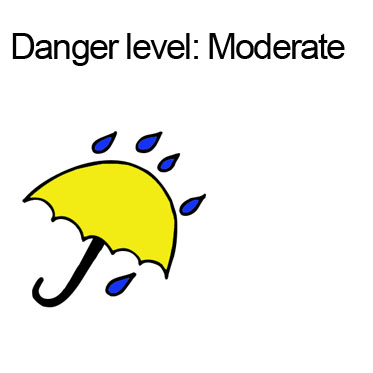
Recommendations: Wear waterproof outer shell. Avoid cotton garments (unless you plan to use your soaked hoodie sweatshirt as a form of weight resistance training). Post-run, use hot shower, electric blanket and/or tea to raise core temperature and fight onset of hypothermia. (Simultaneous use of hot shower and electric blanket not recommended.)
3.) Cloudburst – A sudden, forceful explosion of rainfall that makes you wonder what the ground did to deserve such violent abuse.
Variations: Horizontal cloudburst (a.k.a. hurricane)

Recommendations: Avoid loose-fitting clothing in favor of spandex, swimwear, or full-body wetsuit. In extreme cases, swimming goggles and galoshes may be necessary.
4.) Sleet – Half-frozen precipitation with the consistency of a 7-Eleven Slurpee. (Less delicious than a 7-Eleven Slurpee.)
Variations: Hard sleet (more than 50% frozen), soft sleet (less than 50% frozen)

Recommendations: Wear long, thick tights to better absorb impact and moisture. Brimmed hat (e.g. Souvenir Mexican sombrero, because what else are you going to use that for?) may help deflect sleet globs away from face.
5.) Graupel – Small, spherical pellets of hardened snow. Often mistaken for vanilla Dippin’ Dots. (Less delicious than vanilla Dippin’ Dots.)
Variations: Mega-graupel (Think giant Dippin’ Dots. Still no resemblance in taste.)

Recommendations: Barring unusually strong gusts of wind, graupel is relatively harmless and can be treated as regular snow. Dress accordingly.
6.) Hail – Small bits of ice that vary in size and shape; the most volatile and unpredictable of all types of spring precipitation. Famous for causing headaches, both directly (e.g. runners hit repeatedly in the face and head) and indirectly (e.g. car insurance agents bombarded with claims following a particularly violent storm).
Variations: Miniature hail (think uncooked rice), giant hail (size ranges from golf ball to grapefruit)

Recommendations: Avoid outdoor activity if possible. If you are a diehard crazy who must run, consider wearing leather chaps, helmet and/or protective face shield.
Wednesday, March 16, 2011
Spring running survival guide
It’s been months since you last saw the pavement on your street, so when you begin to notice patches of asphalt peeking through the melting layers of muddy slush, you can’t wait to reacquaint yourself with the pleasures of running on solid ground. With no more black-ice booby traps to watch out for, you are anxious to hit the road and run as fast and far as you please, throwing caution to the 35-mile-an-hour wind.
But while threats of frostbite and hypothermia may have dwindled with the coming of spring, the season of rebirth brings with it a host of new dangers. Here is a breakdown of the top spring running hazards with suggestions on how to handle them:
1.) Ill-behaved hillbilly dogs – It’s a sunny spring day, so you decide to head to your favorite park for a nice afternoon jog. When you arrive, you find that (literally) everyone and their dog had the exact same idea. Seriously, it’s like people have come out of the hills, venturing into city limits for the first time in months to buy horse feed and kerosene. If this is the case, it’s unlikely that they’ve read the paper in the last 15 years, meaning they are completely unaware of the local leash law. You round the bend and come up fast behind a pair of unrestrained hounds, spooking them and triggering their defense instinct. What do you do? Kick them? Mace them? No, the animal-lover in you would never hurt someone’s pet, but you’re about three seconds away from a dozen stitches and a rabies shot. They’re closing in fast…if only you had a way to redirect their attention. This type of situation is the precise reason why savvy spring runners have a few sticks of Pup-Peroni on them at all times. Reach for the treats, chuck them into the air, and make a break for it. Trust me, no dog—or even some humans—can resist these delicious nuggets of hardened meat product.
2.) Obese woodland creatures – After coming out of hibernation, the neighborhood squirrels made a beeline for your garbage can, where they ate themselves silly on pizza crusts and expired cottage cheese. Now they’re fat and on the verge of developing type 2 diabetes. They can handle only short bursts of physical activity, so after darting onto the sidewalk to claim a stray acorn, they become so exhausted that they cannot summon the energy to move even though you are about to trample over them. Luckily, you’ve spent the winter practicing speed and agility drills in preparation for this exact moment. Just as the chubby rodent comes into your field of view, you launch into a lateral skate jump, barely averting a messy road kill disaster.
3.) Discarded objects – As temperatures spike to near-tropical levels (we’re talking high 40s and low 50s) the layers of snow and ice will begin to recede, revealing an entire winter’s worth of lost and forgotten items. From unwanted Happy Meal toys (because hey, that Buzz Lightyear action figure looked way cooler in the commercial) to freeze-dried dog turds, the ground is littered with abandoned articles just waiting to ruin your day. This is not the season to zone out and attempt to Zen your way through a run—that’s an open invitation for poopy shoes and a sprained ankle. Keep all five senses on high alert, and you’ll avoid (literally) finding yourself in deep doo-doo.
4.) Potholes – It’s been a long, hard winter (curse you Dick Cheney and your weather machine!) and all that cold air and moisture has wreaked havoc on paved roads. Your city looks like a third-world country, dotted with craters so big they could easily be mistaken for UFO crash sites. The numerous pavement pockmarks are particularly unkind to low-riding vehicles—like the timelessly sexy PT Cruiser—but they present an even more dangerous situation to spring road runners like you and me. Losing your balance on a patch of uneven pavement could lead to any number of ailments, from a twisted ankle to lockjaw. So be aware of your surroundings, and stick to the sidewalk whenever possible.
Subscribe to:
Posts (Atom)